

1. Introduction
VOCATIONAL SCHOOL FOR COMPUTER PROGRAMMING AND INNOVATION is a candidate school* for the International Baccalaureate (IB) Diploma Programme and pursuing authorization as an IB World School. IB World Schools share a common philosophy—a commitment to improve the teaching and learning of a diverse and inclusive community of students by delivering challenging, high quality programmes of international education that share a powerful vision.**
*Only schools authorized by the International Baccalaureate can offer any of its four academic programmes: the Primary Years Programme (PYP), the Middle Years Programme (MYP), the Diploma Programme or the IB Career-related Certificate (IBCC). Candidate status gives no guarantee that authorization will be granted. For further information about the IB and its programmes, visit www.ibo.org
**Mission Statement from the IB
The International Baccalaureate aims to develop inquiring, knowledgeable and caring young people who help to create a better and more peaceful world through intercultural understanding and respect. To this end the organization works with schools, governments and international organizations to develop challenging programmes of international education and rigorous assessment. These programmes encourage students across the world to become active, compassionate and lifelong learners who understand that other people, with their differences, can also be right.
2. What is an IB education?
The IB continuum of international education for students aged 3 to 19 years old is unique because of its academic and personal rigour. We challenge students to excel in their studies and in their personal development. We aim to inspire a love of learning throughout life that is marked by enthusiasm and empathy. The IB aspires to help schools develop well-rounded students who respond to challenges with optimism and an open mind, are confident in their own identities, make ethical decisions, join with others in celebrating our common humanity and are prepared to apply what they learn in real-world, complex and unpredictable situations.
3. What is the IB Diploma Programme?
The IB Diploma Programme is an academically challenging and balanced programme of education, with final examinations, that prepares students aged 16 to 19 for success at university and in life beyond. It has been designed to address the intellectual, social, emotional and physical well-being of students. The programme has gained recognition and respect from the world’s leading universities.
4. The curriculum
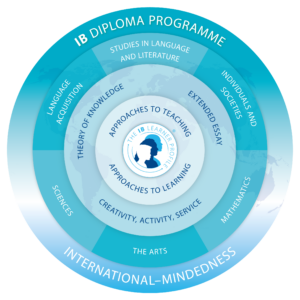
DP students must choose one course from each of five subject groups delivering a breadth of knowledge and understanding in language and literature, individuals and societies, the sciences and mathematics. Furthermore, students must also choose either an arts course from the arts group or a second course from one of the other subject groups. DP courses can be taken at higher level (HL) or standard level (SL). At least three, and not more than four, are taken at HL (240 teaching hours), while the remaining courses are taken at SL (150 teaching hours). SL courses ensure students are exposed to a range of disciplines that they might otherwise opt out of, and HL courses allow students to spend more time with subjects they are more interested in by exploring options in addition to the SL core curriculum. In this sense, all DP courses, regardless of whether they are SL or HL, are integral to the programme. Most DP subjects are taught and assessed in English. Two courses are classified as interdisciplinary, meaning that they satisfy the requirements of more than one subject group.
- Literature and performance (studies in language and literature subject group and the arts subject group)
- Environmental systems and societies (individuals and societies subject group and sciences subject group)
In addition to disciplinary and interdisciplinary study, the DP features three core elements that broaden students’ educational experience and challenge them to apply their knowledge and skills.
5. The Diploma Programme core
The extended essay (EE) requires students to engage in independent research through an in-depth study of a question relating to one of the DP subjects they are studying. The world studies EE option allows students to focus on a topic of global significance, which they examine through the lens of at least two DP subjects.Theory of knowledge (TOK) develops a coherent approach to learning that unifies the academic disciplines. In this course on critical thinking, students inquire into the nature of knowing and deepen their understanding of knowledge as a human construction. Creativity, activity, service (CAS) emphasizes helping students to develop their own identities in accordance with the ethical principles embodied in the IB mission statement and the IB learner profile. CAS complements a challenging academic programme in a holistic way, providing opportunities for self-determination, collaboration, accomplishment and enjoyment. It involves students in a range of activities alongside their academic studies throughout the DP. The three strands of CAS are creativity (exploring and extending ideas leading to an original or interpretive product or performance), activity (physical exertion contributing to a healthy lifestyle) and service (collaborative and reciprocal engagement with the community in response to an authentic need)
6. Assessment
Students take written examinations at the end of the programme, which are marked by external IB examiners. Students also complete assessment tasks in the school, which are either initially marked by teachers and then moderated by external moderators or sent directly to external examiners. The grades awarded for each course range from 1 (lowest) to 7 (highest). Students can also be awarded up to three additional points for their combined results on TOK and the EE. The diploma is awarded to students who gain at least 24 points, subject to certain minimum levels of performance across the whole programme and to satisfactory participation in the CAS requirement. The highest total that a DP student can be awarded is 45 points. Assessment is criterion-related, which means student performance is measured against specified assessment criteria based on the aims and objectives of each subject’s curriculum, rather than the performance of other students taking the same examinations.
7. Research
Whether conducted in collaboration with the IB or independently, research generally suggests that an IB education has a positive impact on schools, students and teachers. Research plays a central role
in the development, quality assurance and assessment of impact of the IB programmes and services. The IB conducts research in two key areas: programme impact research, which investigates the implementation and impact of IB programmes, and programme development research, which supports the development review of all programme curriculum and pedagogy. Research conducted both by the IB and external bodies show the DP curriculum, and assessment compares favourably to other qualifications. To review latest research on the DP visit www.ibo.org/research.
© International Baccalaureate Organization
8. DP subject groups at Vocational School for Computer Programming and Innovation
Group 1 – Studies in language and literature: Bulgarian Literature (SL)
Group 2 – Language acquisition: English B (HL) and German ab initio (SL)
Group 3 – Individuals and Societies: Digital Society (SL)
Group 4 – Sciences: Computer Science (HL)
Group 5 – Mathematics: Analysis and Approaches (HL)
Group 6 will be replaced by an additional Group 2 subject (German), in accordance with IB DP regulations.
8.1 Group 1 – Studies in language and literature: Bulgarian Literature (SL)
The courses offer a wide range of texts, enabling students to develop the ability to understand the complexity, richness, and nuances of language in different contexts. Students choose to study a language in which they are academically proficient. Through the course, students develop:
- a personal appreciation of language and literature.
- critical thinking skills when working with texts from different periods, styles, and genres.
- an understanding of the formal, stylistic, and aesthetic qualities of texts.
- strong written and oral communication skills.
the ability to evaluate cultural differences in perspective. - an understanding of how language shapes and sustains different ways of thinking.
The DP programme aims to develop a lasting interest in language, literature, and the richness of human expression.
8.2 Group 2 – Language acquisition
The primary focus of language courses is the acquisition and use of language in a variety of contexts and for different purposes, while encouraging an understanding of another culture through its language. These courses are designed for students with prior experience in learning the language.
8.3 Group 3 – Individuals and Societies: Digital Society (SL)
Digital Society is an innovative subject within the Individuals and Societies group that explores the int
eraction between people, technology, and the digital environment. It develops critical thinking, analytical skills, and an understanding of how digital technologies transform society, culture, politics, and the economy.
Within the course, students:
- analyse the role of digital media, social networks, and online communication;
- explore topics such as artificial intelligence, algorithms, and big data;
- discuss ethical, legal, and social issues related to digitalisation;
- learn to evaluate the reliability of information and develop digital literacy;
- investigate global challenges and opportunities in the digital age.
The aim of the subject is to prepare students for an active and responsible role in an interconnected and digitalised world.
8.4 Group 4 – Sciences: Computer Science (HL)
Students develop programming skills as a key element in building analytical thinking and problem-solving abilities applicable across all areas of learning.
8.5 Group 5 – Mathematics – Analysis and Approaches (HL)
Mathematics courses in the DP are designed to meet a range of student needs and interests. The Mathematics: Analysis and Approaches HL course is aimed at students with a strong interest in mathematics and theoretical concepts. The course aims to:
- develop mathematical knowledge, concepts, and principles;
- encourage logical, critical, and creative thinking;
- build skills of abstraction and generalisation;
- prepare students for university studies in fields such as mathematics, engineering, physics, computer science, and economics.
The students at Vocational School for Computer Programming and Innovation will be supported throughout the programme by the IB DP Coordinator, CAS Coordinator, EE Coordinator, TOK Coordinator, all Subject teachers, and the School counseling services.
9. IB Student Profile
The IB Student Profile represents the mission of the organization, embodying the outcomes that modern 21st-century education aims to achieve. It is a long-term vision for education, inspiring, motivating, and focusing the work of schools and teachers around a common goal.
The profile aims to develop learners who are:
- Inquirers
- Knowledgeable
- Thinkers
- Communicators
- Principled
- Open-minded
- Caring
- Risk-takers
- Balanced
- Reflective
10. Benefits
The IB Diploma Programme offers a rigorous academic and personal preparation that equips students with the knowledge, skills, and learning habits required for success in higher education. As a result, IB graduates are highly regarded by universities worldwide and are often considered preferred applicants. Having already developed strong academic independence, critical thinking, and time-management skills, IB students demonstrate a significantly lower dropout rate during the first years of university study.
The International Baccalaureate Diploma is internationally recognized as a prestigious and demanding qualification, opening doors to some of the world’s most respected universities. Holding an IB Diploma substantially increases students’ chances of admission to leading higher education institutions across the globe.
Students at the Vocational High School for Computer Programming and Innovation will benefit from a unique academic pathway, earning two diplomas upon graduation: the International Baccalaureate Diploma and the Bulgarian High School Diploma, providing them with both international recognition and national qualification.